The High Street Test Kitchen: How Empty Shops Could Become Britain’s Cheapest Launchpads
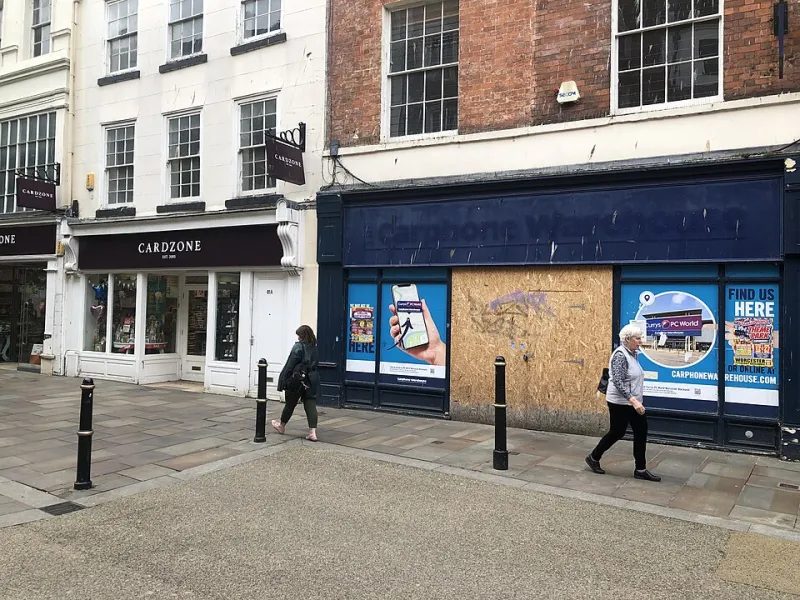
Photo: Richard Webb , CC BY-SA 2.0, via Wikimedia Commons
Walk through almost any UK town centre in 2026 and you will see the same thing: good buildings with paper in the windows. Some are between tenants. Some are waiting for a landlord to decide. Some have been empty so long that the local Facebook group has started calling them by name. The standard response is to mourn the loss of retail. A more useful response is to ask what else a shop can do.
An empty unit is not just a hole in the high street. It is cheap, flexible, visible infrastructure. It has a door, a window, power, a toilet and a location people already know. For a local founder testing a food idea, a repair business, a design studio or a social enterprise, that is often more valuable than a serviced office on a business park. The opportunity is not to fill windows with any old thing. It is to use the space to build businesses that stay.
Why shops beat business parks
The obvious advantage is cost. A short-term licence on a vacant unit can be a fraction of the rent on a conventional office or workshop. But the deeper advantage is visibility. A high street unit puts a business in front of people who would never download an app, attend a networking event or read a startup newsletter. That matters for customer discovery. It also matters for trust.
Ground-floor shops are usually accessible, connected by public transport and close to the services that small businesses need: banks, post offices, cafés, advice centres. A unit can work as a shop, a studio, a classroom, a repair café or a meeting room. The front window is a marketing channel. The back room is a workshop. The pavement is a testing ground.
The barriers are real
None of this is as simple as handing over keys. Planning rules can be confusing, particularly where a change of use or building work is needed. Landlords worry about insurance, rates and getting stuck with the wrong tenant. Councils worry about liability, procurement and the risk of being seen to favour one business over another. Fire safety, accessibility and building regulations all have to be dealt with.
There are tools that can help. In England, high street rental auctions give councils powers to let long-term vacant units, though they are not a silver bullet. Meanwhile-use agreements, pop-up leases and community asset transfers can move faster. Permitted development rights and flexible use classes have made some changes easier, but they are no substitute for good local judgement.
A practical model: the high street test kitchen
The most promising model is not a single shiny hub. It is a network of small, low-cost spaces with shared support. Think of it as a high street test kitchen. The front of the unit is a shop window for retail, exhibitions or drop-in advice. The middle is a coworking table and a kettle. The back is a workshop, studio or small kitchen. The lease is three to six months, all-inclusive, with a clear route to stay longer if the business works.
A council, business improvement district or community land trust can run the space. A local college can provide training. A credit union or community bank can offer basic finance. An anchor tenant, such as a library, a repair service or a post office counter, can bring footfall. The point is not to subsidise forever. It is to lower the cost of trying, so that more people can find out whether their idea has customers.
What councils and landlords can do
- Audit empty units and publish a simple register of available spaces, lease terms and contacts.
- Standardise a short meanwhile licence and an insurance pack so every small tenant does not have to start from scratch.
- Offer small grants for fire safety, accessibility and basic fit-out, not just marketing.
- Use rental auctions and compulsory purchase powers where a unit has been empty for years and the owner will not engage.
- Partner with colleges, enterprise agencies and social enterprises to run the space and support tenants.
- Measure what matters: businesses launched, jobs created, social value, footfall and survival rates after two years.
- Keep a ring-fenced share of units for local startups and social enterprises even as the high street recovers.
The social enterprise angle
Social enterprises are natural tenants for this kind of space. They often need exactly what an empty shop offers: visibility, accessibility and low fixed costs. A repair café can use a former hardware shop. A community food project can use a former takeaway. A training kitchen can use a former restaurant. A credit union can use a former bank branch.
Community shares can fund the fit-out. Councils can use social value in procurement to support the organisations running the space. Landlords get income, activity and someone who cares about the building. The model can become self-sustaining: as units fill and rents rise, a proportion of the income can be recycled into the next cohort of startups.
Don't just fill windows
The risk is that high street revival becomes a race to recreate 1995 with better lighting. Britain does not need another identikit coffee chain in every town. It needs a pipeline of local businesses that can grow into the units next door. Some of the experiments will fail. That is the point. A cheap failure in a vacant shop is better than an expensive empty unit and a town centre that feels closed.
The high street has always been a place where people try things. Markets, arcades, department stores and pop-ups were all innovation formats in their day. In 2026, the UK has thousands of empty units and thousands of people with ideas. Putting the two together will not solve every problem. But it is one of the cheapest, most visible and most human ways to build a better Britain, one shop at a time.